ſ
The Longeſſifier
or, the Long-S-ifier
This ſimple Tool allows one to live as would a true 16th-17th Century Dandy, & to uſe long ſ's in any & all ſteads & places moſt appropriate!
Rules for uſing the long ſ
The long ſ has a long & ſtoried hiſtory in printing in the Latin alphabet. The uſe of two Forms of S—one for the middles of Words, & one for the Ends—is derived from the Greek uſage, where there are still to this very day two lowercase forms of the letter ſigma.
The rules governing the uſe of the two forms changed over time and between contexts (and often differed even within the ſame text). Only one rule ſtood out universally, stated thusly in An Universal Etymological English Dictionary by Nathan Bailey:
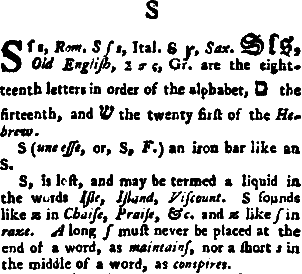
Directly quoting this blog post from BabelStone by Andrew West, the Rules for uſing the long ſ boiled down as ſuch in his meta-analyſis of Google N-grams:
- short s is uſed at the end of a word (e.g. his, complains, ſucceſs)
- short s is uſed before an apostrophe (e.g. clos'd, us'd)
- short s is uſed before the letter 'f' (e.g. ſatisfaction, misfortune, transfuſe, transfix, transfer, ſucceſsful)
- short s is uſed after the letter 'f' (e.g. offset), although not if the word is hyphenated (e.g. off-ſet)
- short s is uſed before the letter 'b' in books publiſhed during the 17th century and the firſt half of the 18th century (e.g. husband, Shaftsbury), but long ſ is uſed in books publiſhed during the ſecond half of the 18th century (e.g. huſband, Shaftſbury)
- short s is uſed before the letter 'k' in books publiſhed during the 17th century and the firſt half of the 18th century (e.g. skin, ask, risk, masked), but long ſ is uſed in books publiſhed during the ſecond half of the 18th century (e.g. ſkin, aſk, riſk, maſked)
- Compound words with the firſt element ending in double s and the ſecond element beginning with s are normally and correctly written with a dividing hyphen (e.g. Croſs-ſtitch, Croſs-ſtaff), but very occaſionally may be written as a ſingle word, in which caſe the middle letter 's' is written ſhort (e.g. Croſsſtitch, croſsſtaff).
- long ſ is uſed initially and medially except for the exceptions noted above (e.g. ſong, uſe, preſs, ſubſtitute)
- long ſ is uſed before a hyphen at a line break (e.g. neceſ-ſary, pleaſ-ed), even when it would normally be a ſhort s (e.g. Shaftſ-bury and huſ-band in a book where Shaftsbury and husband are normal), although exceptions do occur (e.g. Mans-field)
- double s is normally written as double long ſ medially and as long ſ followed by short s finally (e.g. poſſeſs, poſſeſſion), although in ſome late 18th and early 19th century books a different rule is applied, reflecting contemporary usage in handwriting, in which long s is used excluſively before short s medially and finally
- short s is uſed before a hyphen in compound words with the firſt element ending in the letter 's' (e.g. croſs-piece, croſs-examination, Preſs-work, bird's-neſt)
- long s is maintained in abbreviations ſuch as ſ. for ſubſtantive, and Geneſ. for Geneſis (this rule means that it is practically impoſsible to implement fully correct automatic contextual substitution of long s at the font level)
As is obvious, there are quite a few inconſiſtencies in theſe rules, which appear to have been largely semi-formal and to a great degree up to the whims of the editor. This notwithſtanding, this webſite gladly provides two alternative options:
- Normal Mode/Old Style: This ſetting permits the Uſer to change between 16th/early 17th-Century Rules & late 17th/early 18th Century Rules. Old Style differs from Normal Mode in that long ſ is not uſed immediately adjacent to the Letters b and k.
- Double ſ/ſs/ß Mode: This allows the Uſer to ſwap between three different alternative ſets of rules determining whether long ſ or ſhort s is used next to one another in the middle of a word.
About this ſite
This ſite was created by Todd W. Smith on a whim, moſtly becauſe nothing ſimilar immediately popped up during a curſory Google ſearch.